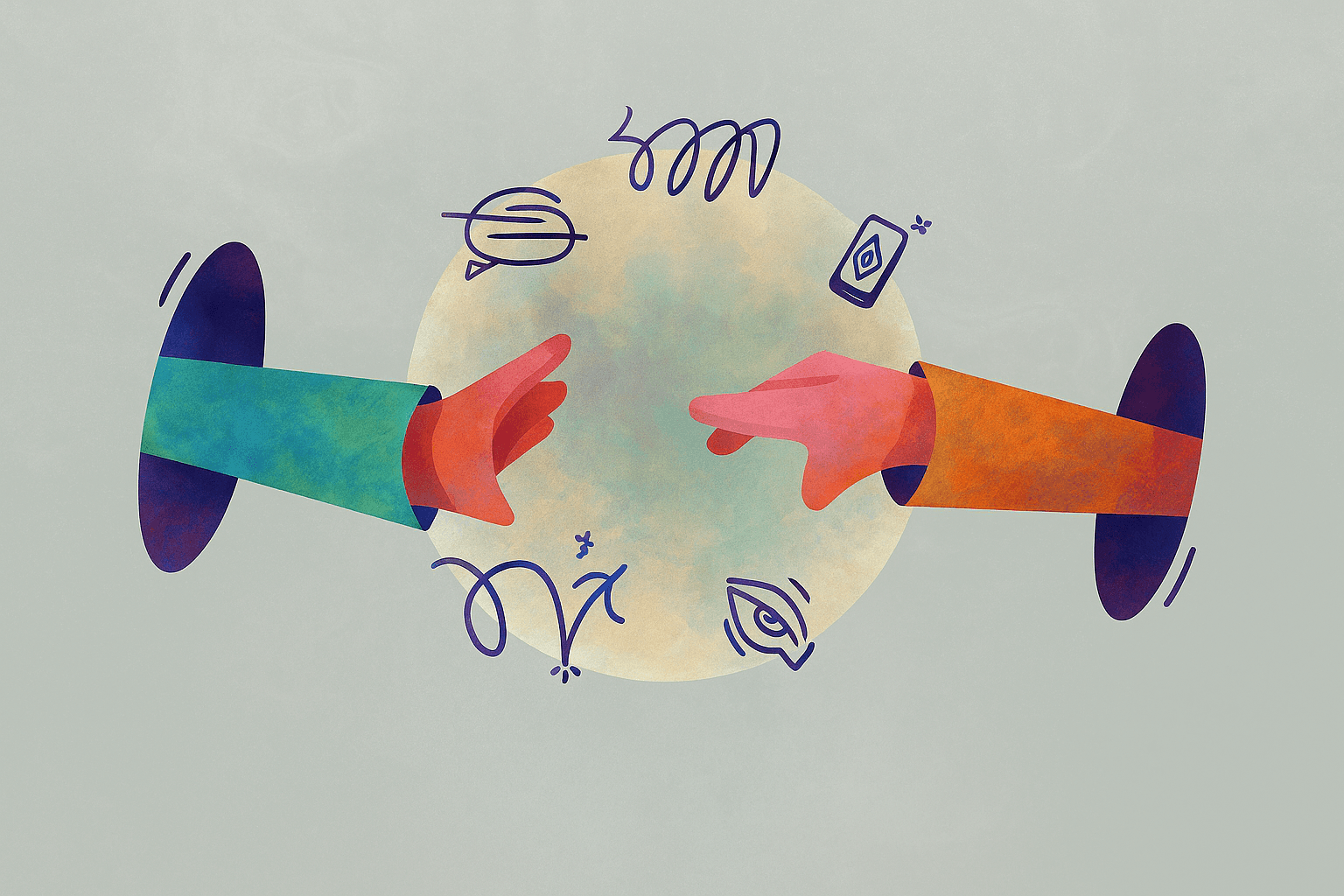
Design roles today blend everything — product, strategy, research, writing, even motion and branding.
Somewhere along the way, "a good designer" started to mean "someone who can do everything."
It’s exciting and empowering — you feel seen as a multidisciplinary mind. But for many, it shifts focus from craft to survival.
According to a Nielsen Norman Group study, when organizations expect one person to cover research, design, strategy, and delivery, the quality of each inevitably suffers.
And I see that happening more and more often.
We love the idea of the “full-stack” designer — someone who can handle the entire journey.
And yes, understanding how all pieces connect is important.
But there’s a difference between seeing the whole picture — and being responsible for it. When you’re stretched across too many roles, design becomes diluted — a collection of tasks instead of a thought process.
As UX Collective once put it,
"Designers think through making. Product managers think through prioritizing. Both perspectives matter — but they shouldn’t merge into one."
It’s not that curiosity kills quality.
It’s that overextension kills focus.
I’m not against versatility. It’s what helped me grow — through research, systems, and psychology.
But there’s a quiet shift happening when "versatile" quietly replaces "skilled."
The craft fades.
The joy of shaping ideas through form starts to feel like a luxury — something you do after the "real work" is done.
That’s when designers start losing the craft that once made their work sharp — and meaningful.
InVision's "New Design Frontier" report found that the most mature teams — those with real business impact — are not the ones trying to do everything.
They’re the ones that protect design focus and depth, allowing designers to go deep, not wide.
Design isn’t about doing everything.
It’s about seeing clearly, simplifying, making meaning tangible.
I keep seeing more designers talk about this — on X, in essays, in interviews. It’s comforting to know I’m not alone in feeling this friction.
Many of us love solving problems — but also love that quiet, subtle part of the work: the balance between logic and beauty, the sense of flow when something clicks.
That’s the space where design becomes thought, not decoration.
As Harvard Business Review and IDEO describe, the value of design lies not in taking over every function —
but in reframing problems and helping teams see from a different angle.
I miss seeing that space protected.
Maybe we don’t need to “own the whole product” — just the clarity behind it.
Maybe we just need to own our process — with care, curiosity, and intention.
Because clarity, empathy, and visual intelligence aren’t “add-ons”.
They are what design actually is.
That’s already a lot. More than enough — and still beautifully human.